About the author
About Michael
Independent Retail Trader | ITPM Graduate | Long/Short Equity & Options Trading
 By Michael, mentored ITPM graduate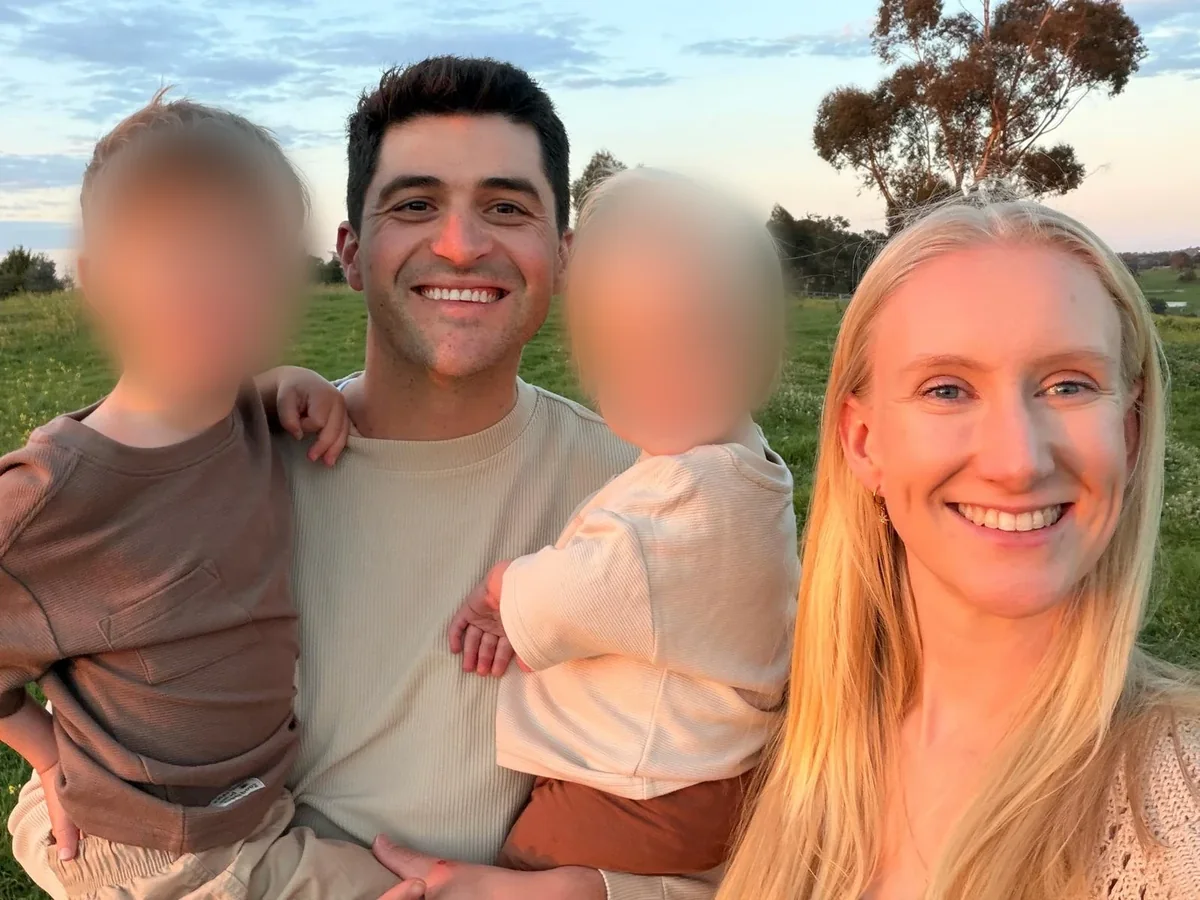
I’m Michael, an Australian retail trader focused on US equities, options and long/short portfolio management.
I was introduced to trading at the start of 2022 with very little market experience, and started ITPM that same year. Since then, I’ve completed the Institute of Trading and Portfolio Management (ITPM) education programs, undertaken mentoring and spent years developing and refining my own systematic trading process.
Today, I combine the foundations I learned through ITPM with my own research into market environments, technical analysis, price action, market breadth and risk management.
The Institute Trader is where I document that journey. What I’ve learned, what has worked, what hasn’t, and the realities of applying a trading process with real money.
Why I Started Trading
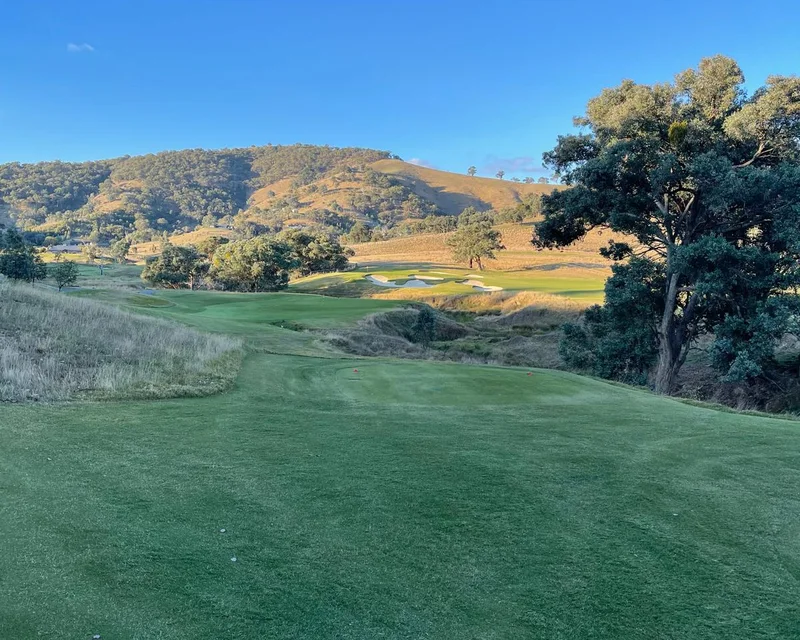
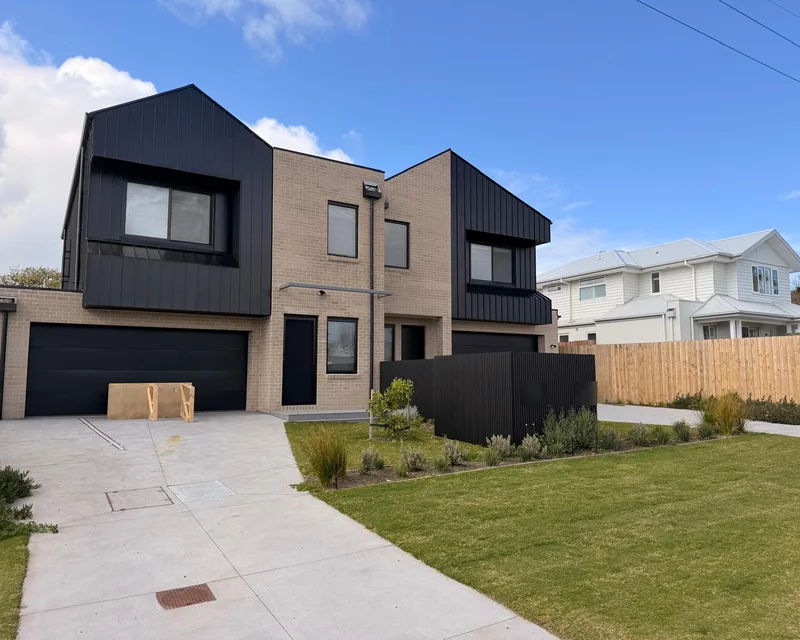
Before trading, I worked as a development manager at a golf course while also developing residential townhouses.
I enjoyed the challenges of business and development, but over time I found the industry becoming increasingly restricted by regulation and red tape. The opportunities to build wealth and pursue new projects were becoming more difficult to realise.
I began looking for another way to build wealth over the long term.
Trading appealed to me because it offered the possibility of developing a skill that wasn’t necessarily tied to my existing industry.
But I had a lot to learn.
My early experience consisted of a CommSec account, a handful of trades and a couple of wins. I didn’t understand what was driving the market, how to construct a portfolio or how to manage risk within a repeatable process.
Looking back, those early wins were largely meaningless. I was trading without really knowing what I was doing.
Discovering ITPM
ITPM was introduced to me by someone who was teaching me about trading at the time.
It was hard for him to convey his approach to trading to me, because I wasn’t yet privy to the jargon or the level of knowledge he possessed. So he strongly recommended the Institute of Trading and Portfolio Management.
He introduced me to their YouTube channel, where I began watching Anton Kreil’s videos.
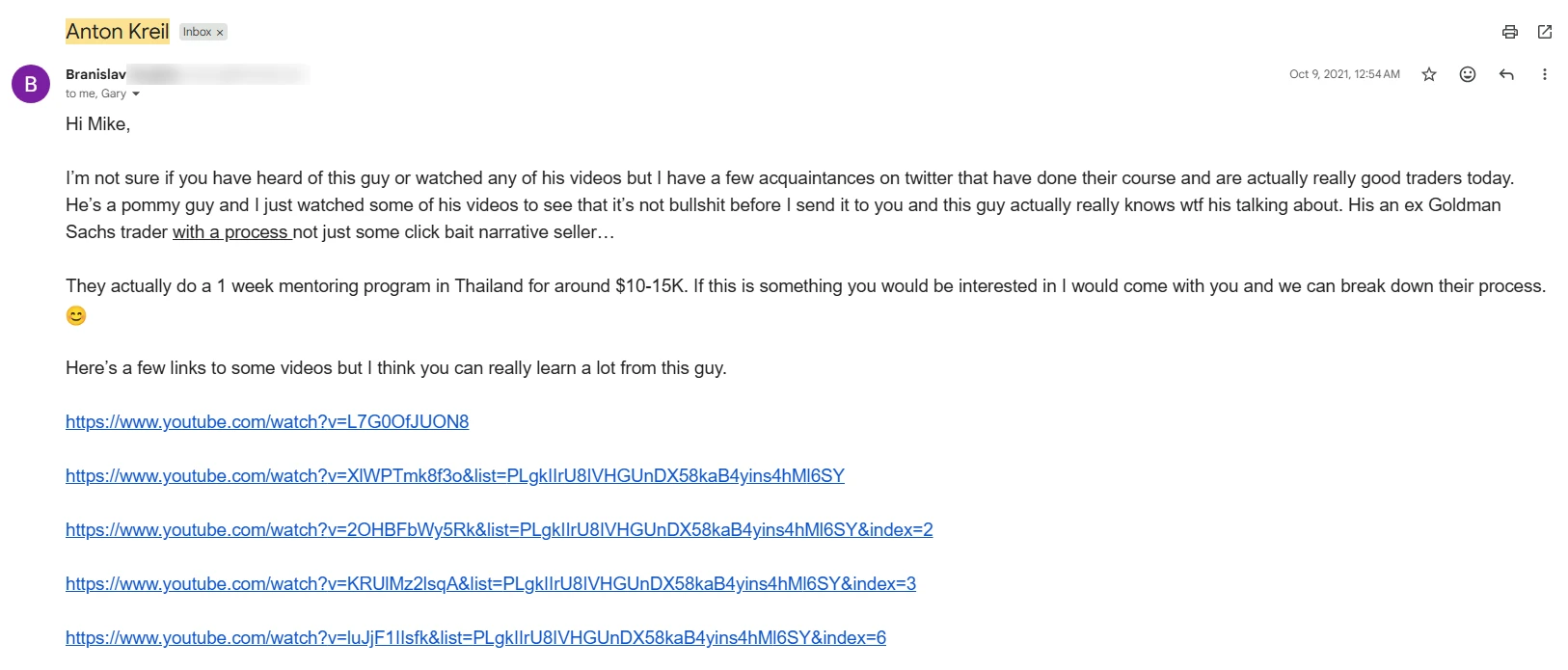
After researching the organisation and learning more about its approach to markets, I felt I’d discovered something different from the trading education I’d previously encountered.
I also did some background checks to verify that Anton Kreil has a genuine institutional background. His regulatory history is on the UK Financial Conduct Authority register, so you can check it for yourself.
At the time I also watched Million Dollar Traders, the BBC series featuring Anton Kreil, which gave me another look at how he approaches the markets.
Verify Anton Kreil on the FCA register Watch Million Dollar Traders
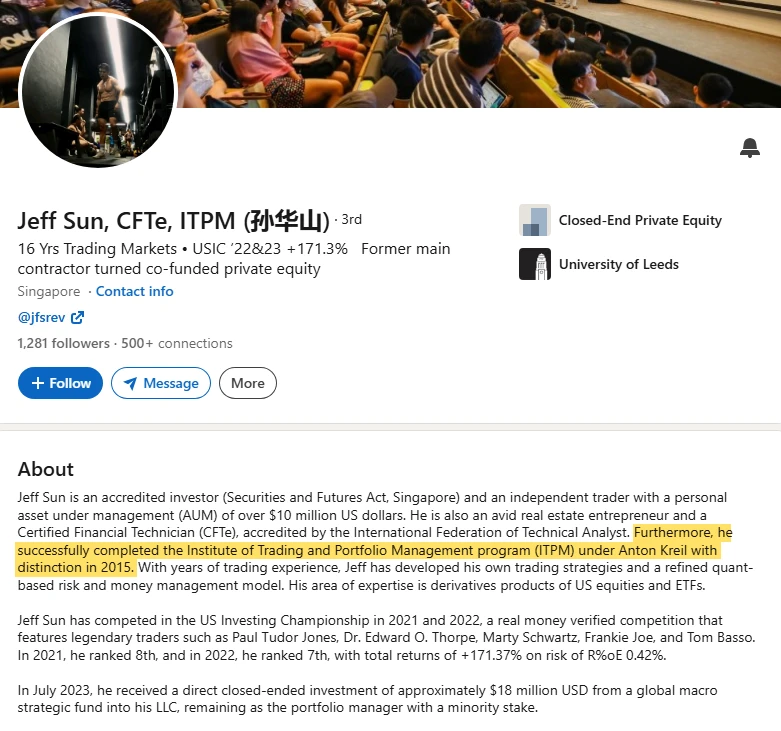
I was also following Jeff Sun on FinTwit at the time. I respected his approach to trading, and knowing he had completed the ITPM courses gave me further confidence to investigate them.
I eventually completed IPLT, PTM 2.0 and POTM, followed by three months of online mentoring with Anthony Iser.
What ITPM Changed About My Trading
The most important thing ITPM taught me wasn’t an entry signal or an individual trading strategy.
It taught me the foundations for a complete trading process.
I began understanding how macroeconomics influences financial markets and why markets are forward-looking mechanisms.
Rather than reacting to headlines or individual price movements, I learned to study leading indicators, assess the prevailing market regime and construct a broader trading thesis.
From there, I could identify sectors and individual companies that aligned with that thesis, using fundamental and qualitative research to refine my ideas.
ITPM also introduced me to the strength of long/short portfolio management.
I stopped thinking about trades purely as individual opportunities and started considering how they interacted within a portfolio, how much risk they contributed and how I could pursue better risk-adjusted returns.
That framework remains the foundation of how I trade today.
From Education to Developing My Own Process
One of the biggest challenges after finishing the courses was turning what I’d learned into a systematic process.
I experienced early success, but I also realised that understanding the material wasn’t the same as executing it consistently.
Over time, I began looking much more closely at my own trading decisions.
I wanted to eliminate unnecessary randomness and reduce the number of variables influencing my results.
If I trade randomly, I should expect random results.
My objective became to develop a process that I could repeat consistently, where decisions were based on identifiable conditions rather than instinct or emotion.
I spent considerable time researching technical analysis and price action, alongside studying many of the strongest-performing trades from the previous decade.
I wanted to understand what characteristics those opportunities had in common and whether any of those characteristics could be incorporated into my own trading.
That research, combined with the principles I’d learned through ITPM, helped me develop a more systematic approach.
Over time, I’ve become more confident in my own process, and these refinements have contributed to improving my trading results.
Situational Awareness: Understanding the Market You’re Trading
One area I’ve spent considerable time developing beyond the original ITPM framework is what I call situational awareness.
Markets move through different environments, and I don’t believe the same bias and positioning will necessarily be equally effective in every one of them.
Understanding where we are in the market cycle, how the major indexes are behaving and what is happening beneath the surface through market breadth can be extremely important.
For me, situational awareness means identifying the conditions in which my trading process is more likely to perform well and recognising when those conditions may be less favourable.
I consider ITPM’s overall trading framework an excellent foundation.
A long/short portfolio is a good way to trade all year round. What I’ve found needs further context and exploration as a trader develops is how the ideas inside that portfolio are formed, and how to adjust your bias as the market environment changes. In my experience, that part isn’t explored in as much depth on the platform.
It’s an area where I’ve continued my own research and developed additional tools and techniques to build on what I learned. I go deeper in Situational Awareness in Trading.
The Mistakes I’m Still Working On
One of the biggest mistakes I continue to make is overtrading.
As I’ve become more confident in my process, I’ve occasionally allowed that confidence to influence my decision-making.
At times, I’ve taken more trades than my rules would ordinarily allow or deviated from the process I’ve worked hard to develop.
That has contributed to larger drawdowns than I would like.
It’s something I’m constantly working to improve.
Having confidence in a trading process is important, but confidence can also become a weakness when it causes you to stop following your own rules.
I believe one of the most important skills in trading is recognising when your own behaviour is becoming a source of risk.
How I Measure Improvement
Ultimately, my trading account is the clearest financial measure of how I’m performing.
But account performance isn’t the only thing I examine.
I regularly review previous trades and ask whether I was satisfied with the decisions I made using the information available at the time.
A losing trade isn’t necessarily a bad trade.
Losses are unavoidable, and I believe traders need to become comfortable with that reality.
What concerns me more is losing money because I’ve ignored my process, broken my rules or made an avoidable decision.
I continually look for those errors and try to eliminate them.
The goal isn’t to win every trade. It’s to improve the quality and consistency of my decisions so that, over a meaningful sample of trades, the process has a better opportunity to produce favourable results.
What Trading Looks Like for Me Today
Trading has become a significant part of my daily life.
I currently spend approximately three hours each day, Monday to Friday, researching markets, reviewing economic conditions and identifying potential trades.
Because I live in Australia and trade US markets, I also structure much of my routine around the US trading session.
I’m often awake for the market open and return for the close, which are the periods when I prefer to manage entries and exits for opportunities on my watchlist. All up, it comes to roughly fifteen hours a week. I wrote about how I make that work in Trading from Australia.
My Trading Process Today
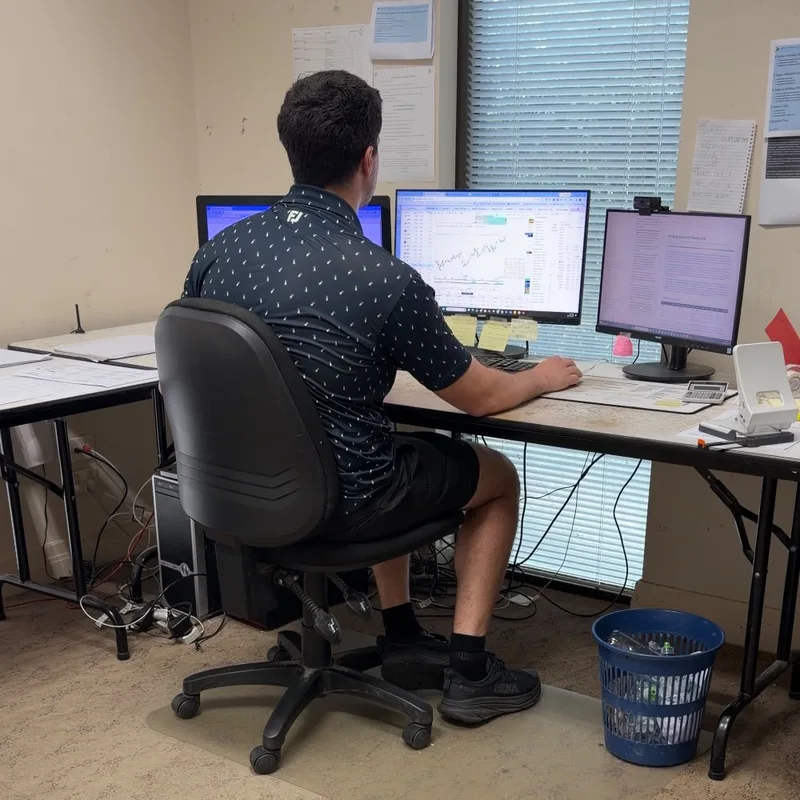
My trading process remains firmly grounded in the foundational principles I learned through ITPM. I continue to manage a long/short portfolio of US equities, primarily expressed through options, while incorporating a deeper understanding of situational awareness, market cycles, market breadth, risk management and price action.
Over time, I’ve built upon those foundations to develop a systematic trading process that I can genuinely call my own. The objective is to eliminate unnecessary randomness, identify favourable market conditions and consistently seek opportunities with attractive risk-adjusted returns.
My process is continually evolving. I regularly review previous trades, critically assess my decisions and study how different market environments influence the performance of my strategies. I believe understanding when and why a particular approach works is just as important as understanding how to execute it.
As my trading account and experience have grown, I’ve also had to adapt to the practical realities of managing larger positions. Certain opportunities that were once attractive have become less suitable because of limitations in options liquidity.
This has pushed me to develop a stronger understanding of liquidity, execution and market dynamics, while increasingly focusing on opportunities with deeper, more liquid options markets.
Ultimately, ITPM provided the foundation, but years of research, experience and continuous refinement have shaped the trading process I follow today.
I am breaking that process down in The Institute Trader Series, a paid video course I am developing for traders who have a foundational understanding of trading and want to make it their own. For exclusive resources and an inside perspective on how I am interpreting the market, join my free newsletter.
My Long-Term Ambition
Trading is something I’m genuinely passionate about.
I spend time studying markets every day, and I’m constantly trying to become a little better at what I do.
My ultimate ambition is to manage other people’s money professionally.
But I’m also realistic about where I am in that journey.
I only started trading in 2022. While I’ve experienced encouraging early results, that doesn’t mean those results will continue indefinitely.
I still have different market cycles and trading environments to experience.
A process that performs well in one environment may struggle in another. I want to continue developing the experience, discipline and track record necessary to navigate those changes.
If I eventually reach the point where I’m qualified and able to manage capital professionally, it will represent an important achievement in my development as a trader.
For now, my focus remains on improving the process, managing my own capital and continuing to learn.
Why I Created The Institute Trader
I started The Institute Trader in 2023 to share my experience with ITPM and help others considering the same educational pathway.
I created it because I wanted to share a perspective that I found difficult to access when I was beginning my own trading education.
There is plenty of content explaining what trading courses offer.
There is much less information about what happens after you’ve completed the education and begin applying the process with real money.
What challenges do you encounter? How do you develop consistency? What happens when your strategy stops working as expected? How do you manage losing periods, mistakes and changes in market conditions?
These are the questions I want to explore.
I share my experience with ITPM, my ongoing development as a trader, and the research and practical lessons that have shaped my approach.
My aim isn’t to convince everyone that trading is right for them or that completing a course will make them profitable.
It’s to provide an informed, first-hand perspective that helps people understand what they’re getting into.
How The Institute Trader Is Evolving
Since 2023, both my trading and my mindset have evolved considerably. Through ongoing 1% daily improvements, practical experience and deep study, I have developed a deeper understanding of trading on top of the ITPM methodology. It has made me a better trader, with a system I can call my own.
As I continue to develop as a trader, I see The Institute Trader evolving alongside me. While ITPM remains a core foundation of my trading, I want this website to become a broader resource for sharing the educational pathways, research, tools and practical lessons that have helped me improve my consistency.
That evolution is what prompted me to recently redesign The Institute Trader. What began as a place to document my ITPM experience is now growing into a broader educational resource, reflecting the knowledge, experience and perspectives I’ve developed along the way.
My goal is to continually improve the quality and depth of the content I share, giving back to the trading community through genuine experiences, independent research and practical education. Whether someone follows the ITPM pathway, explores other educational programs or develops their own independent approach, I hope the lessons I share can help them make more informed decisions and progress in their own trading journey.
Where to See My Work
If you want to check what I’ve said here, this is where the evidence lives.
- My course reviews. An honest review of each course I completed, in ITPM course reviews, including PTM 2.0 and POTM. How I put them together is in how I review ITPM courses.
- My trading results. Broker-reported results from the account I manage, with a redacted Interactive Brokers statement, on my trading results page.
- How I report my results. The method behind those numbers, in how I report my results.
- What happens after the course. How I run the process today is in what trading looks like for me today, and the full breakdown is coming in The Institute Trader Series.
- The process in practice. Articles on situational awareness, market breadth, trading from Australia and how my process developed.
- The research. Why most retail traders lose money, with sources, in Why Are Retail Traders Set Up to Fail?
Questions about any of it? Email me.
Independence & Disclosure
The Institute Trader is an independent website. I’m an ITPM graduate and affiliate, but I’m not employed by ITPM. I may receive commissions when visitors purchase courses through my affiliate links.
The views expressed here are my own, and my trading results are not representative of what other traders should expect.
Trading involves substantial risk, and nothing published on this website constitutes personal financial advice. Read the full disclaimer.